
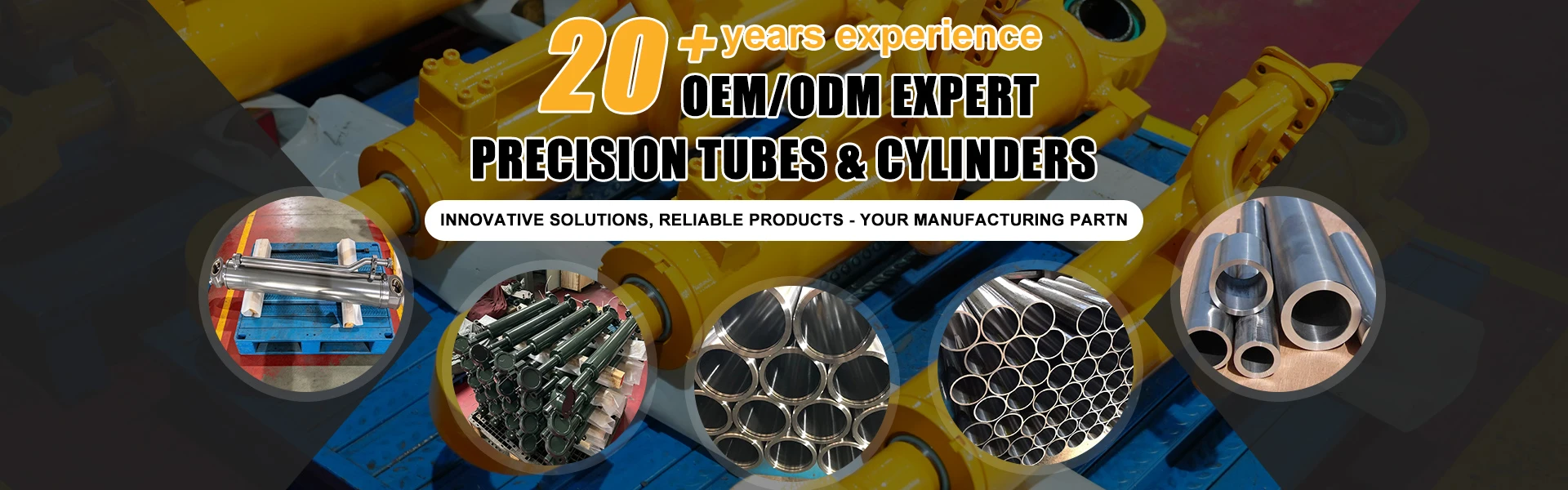
Honed tubes, as a high-precision tube processing product, occupy a vital position in modern industrial manufacturing. Through the honing process, they achieve high-precision, high-quality finishes on the inner bore, and stable dimensional tolerances. They are widely used in hydraulic systems, automotive manufacturing, aerospace, and precision machinery. This article will discuss the technical parameter range, processing characteristics, and typical application scenarios of honed tubes to clarify their core value in the industrial system.
I. Technical Parameter Range of Honed Tubes
The core technical indicators of honed tubes are concentrated in three aspects: inner bore dimensional accuracy, surface roughness, and geometric tolerance. In terms of dimensional accuracy, the inner diameter tolerance of honed tubes is typically controlled within the ISO standard range of H7 to H9. Some high-precision products even achieve micron-level tolerances of ±0.01mm, far exceeding the accuracy level of conventional turning or boring operations. In terms of surface roughness, the honing process uses a cross-grinding grinding action to stabilize the inner bore surface roughness (Ra value) within the range of 0.2-0.8μm, significantly reducing fluid flow resistance and improving sealing performance. Geometric tolerances cover key parameters such as roundness (≤0.005mm), straightness (≤0.02mm/m), and cylindricity (≤0.01mm/m), ensuring the structural stability of the tube under high-pressure and high-speed operating conditions.
In terms of material selection, the base materials for honing tubes are primarily carbon steel (such as 20# and 45# steel), alloy steel (such as 20Cr and 40Cr), and stainless steel (such as 304 and 316L). Stainless steel honing tubes are commonly used in chemical equipment or for food-grade fluid transportation due to their strong corrosion resistance. Carbon steel honing tubes are the mainstream choice for hydraulic systems in construction machinery due to their cost advantages. Furthermore, some specialized applications require copper alloy or titanium alloy honing tubes to meet high-temperature, high-pressure, or lightweight requirements.
II. Processing Characteristics of Honed Tubes
The honing process strictly follows a multi-stage control logic of "roughing - semi-finishing - honing and finishing." A base tube blank is first obtained through cold drawing or machining, followed by the core process of the honing machine. The honing machine uses a honing head loaded with abrasive particles (such as diamond, cubic boron nitride, or silicon carbide) to perform micro-cutting and polishing on the tube's inner bore through a combination of rotation and axial feed. Key process parameters include the honing head speed (typically 100-300 rpm), reciprocating stroke speed (5-20 m/min), and abrasive grit size (80-180 grit for rough honing and 240-600 grit for fine honing). By precisely controlling these variables, a gradient of optimization from roughing to mirror-quality finish can be achieved. Compared to traditional machining methods, honing offers significant advantages: First, it can correct geometric errors left over from previous processes (such as turning or boring), eliminating taper, bulging, or spiral marks on the inner bore. Second, the micro-cutting action of abrasive particles creates uniform, cross-patterned oil reservoirs, significantly improving the tube's wear resistance and lubrication retention. Third, the process eliminates the risk of thermal deformation, making it particularly suitable for the precision machining of thin-walled tubes (wall thickness tolerance ≤ 0.1mm) or high-hardness materials (such as hardened steel).
III. Typical Applications of Honed Tubes
Honed tubes are highly dependent on their high precision and reliability, and are particularly effective in the following areas:
1. Hydraulic and Pneumatic Systems
The inner surface of hydraulic and pneumatic cylinders directly determines the system's pressure transmission efficiency and seal life. The inner bore roughness and dimensional consistency of honed tubes effectively reduce the friction coefficient between the piston and cylinder barrel (by 30%-50%), minimizing leakage risks and extending the maintenance cycle of hydraulic components. For example, hydraulic outrigger cylinders for construction machinery commonly use honed tubes with diameters ranging from 80 to 200 mm, requiring an inner bore roughness of 0.4 μm or less to ensure stable output under heavy loads.
2. Automotive Manufacturing
Automotive engine fuel injection systems, turbocharger connecting pipes, and chassis shock absorber cylinders all require honed tubes. For example, high-pressure common rail fuel lines typically have inner bore diameters ranging from 6 to 12 mm and must meet ultra-smooth surface requirements of Ra ≤ 0.2 μm to prevent injection pressure fluctuations caused by fuel impurity deposits. Turbocharger cooling water pipes, on the other hand, rely on the high-temperature resistance (long-term operating temperature ≥ 600°C) and dimensional stability of honed tubes.
3. Aerospace and Precision Instruments
Hydraulic lines for aircraft engines and micro-cylinders for satellite attitude control systems place extreme demands on material purity and machining precision. Aerospace-grade honing tubes are often made of 316L stainless steel or nickel-based alloys, with internal bore tolerances controlled within ±0.003mm and verified to be free of micro-leakage defects using a helium mass spectrometer. Optical platform support tubes and coordinate measuring machine guide rails used in precision instrumentation rely on the low thermal expansion coefficient of honing tubes (for example, the thermal expansion coefficient of Invar honing tubes is ≤1.2×10⁻⁶/°C) to ensure absolute measurement accuracy.
Conclusion
Honning tubes cover the entire supply chain, from basic dimensional parameters to high-end application scenarios. Their precision processing and flexible material compatibility make them an indispensable foundational component in high-end equipment manufacturing. As Industry 4.0 continues to increase component reliability requirements, the technical standards for honing tubes will further evolve towards ultra-precision (nanoscale surface), multi-functionality (composite coating integration), and green manufacturing (low-energy processing), continuously driving the upgrading and development of related industries.


