
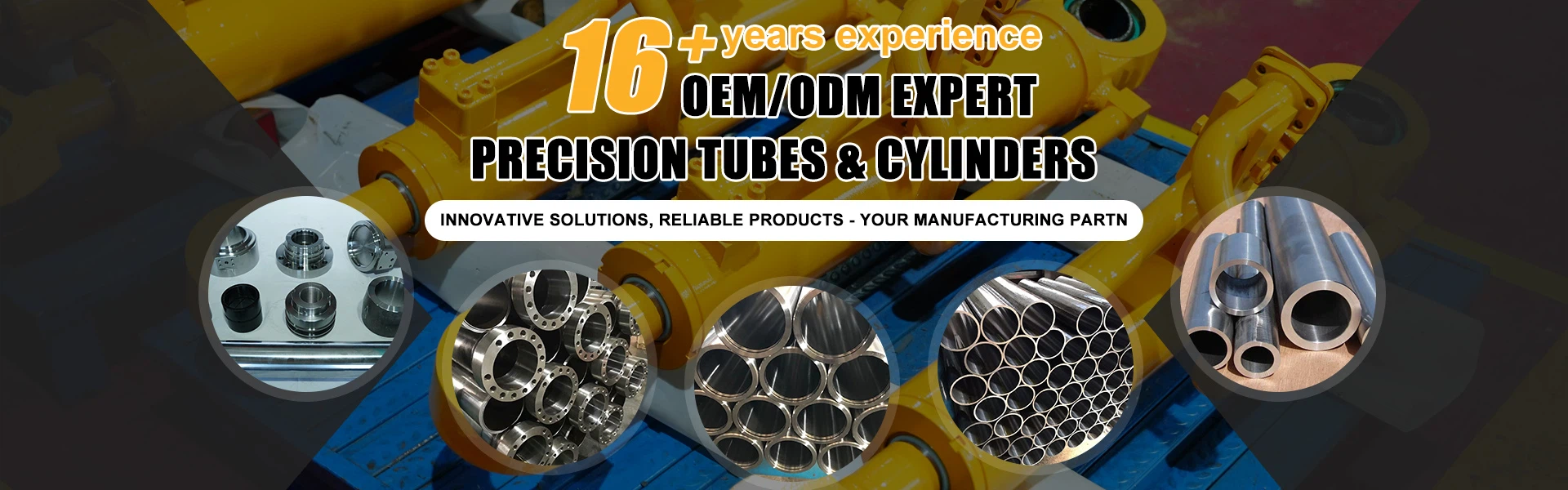
As a crucial actuator in modern mechanical engineering, the development of hydraulic cylinders is deeply rooted in humanity's exploration of fluid statics and mechanical dynamics. From the rudiments of ancient hydraulic machinery to the sophisticated designs of the post-Industrial Revolution era, the evolution of hydraulic cylinders reflects not only technological progress but also humanity's relentless pursuit of efficiency and power.
As early as the ancient Greek and Roman periods, engineers such as Archimedes utilized hydraulic principles to design simple mechanical devices, such as the Archimedean screw. While these devices did not directly utilize hydraulic cylinders, they laid the theoretical foundation for the subsequent application of fluid pressure. In the Middle Ages, devices such as water mills and bellows further demonstrated the practicality of pressure transmission, but these technologies had not yet developed a systematic hydraulic theory.
The true prototype of the hydraulic cylinder emerged in the 17th century, with the proposal of Pascal's principle (the principle of hydrostatic transmission), by French scientist Blaise Pascal: "A stationary fluid in a closed container, a pressure applied at any point is transmitted equally in all directions." This theory provided the scientific basis for the development of hydraulic technology. In the 18th century, British engineer Joseph Bramah invented the Bramah hydraulic press, based on Pascal's principle. This was the first true hydraulic device in history, and its core component already possessed the basic function of a modern hydraulic cylinder-piston movement driven by liquid pressure.
The onset of the Industrial Revolution greatly promoted the practical application of hydraulic technology. In the 19th century, with advances in steel smelting and precision machining, hydraulic cylinders began to be widely used in mine drainage, forging machinery, and railway equipment. British engineer William Armstrong developed the hydraulic accumulator and hydraulic crane in the mid-19th century, further optimizing the structure and performance of hydraulic cylinders. During this period, hydraulic cylinders gradually evolved from experimental devices to industrial standard components, with their materials transitioning from early cast iron to high-strength steel, and sealing technology gradually improving.
Since the 20th century, with advances in internal combustion engines, hydraulic pumps, and precision control technology, hydraulic cylinder designs have become more diverse, with widespread application in construction machinery (such as excavators and cranes), aerospace, military equipment, and automated production lines. Modern hydraulic cylinders not only strive for high load capacity and long life, but also further enhance efficiency and reliability through composite piston rods, low-friction sealing technology, and intelligent hydraulic systems.
A review of the history of hydraulic cylinders clearly illustrates humanity's transition from empirical mechanical applications to theory-driven engineering innovation. From the introduction of Pascal's principle to the integration of modern intelligent hydraulic systems, hydraulic cylinders are not only the core of fluid power technology but also a crucial symbol of the progress of industrial civilization. In the future, with the further integration of materials science and digital control, hydraulic cylinders will continue to play a key role in a wider range of fields.


