
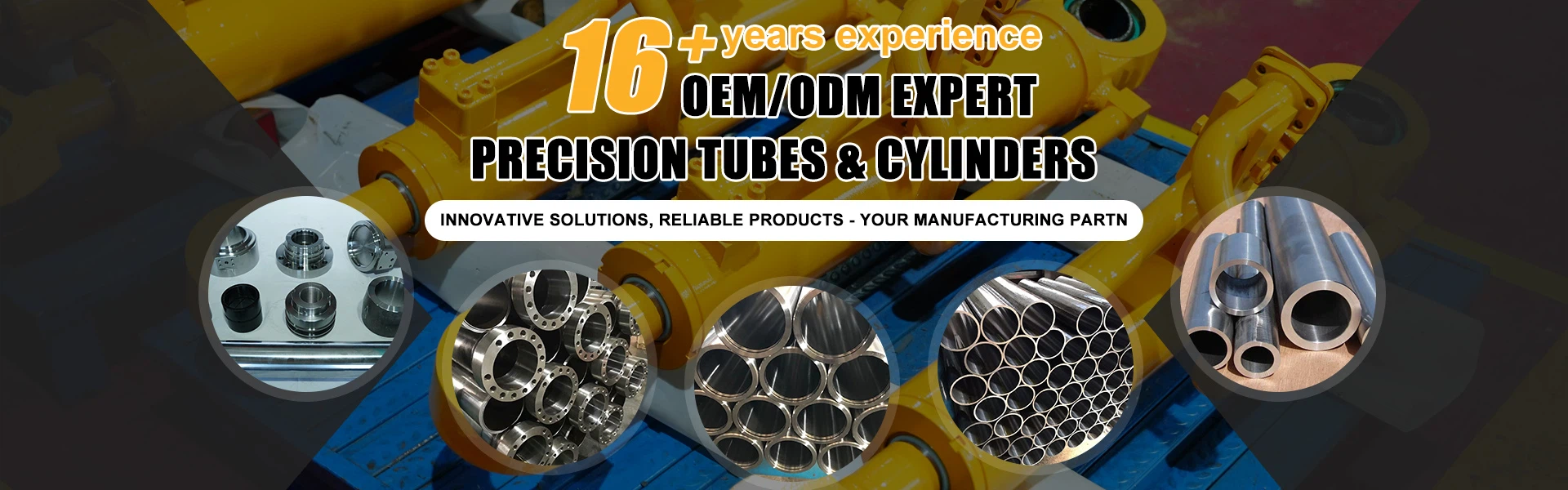
As the core actuator in hydraulic systems, hydraulic cylinders' technical characteristics directly impact the performance and reliability of mechanical equipment. With the rapid development of industrial automation and heavy equipment, hydraulic cylinders have continuously optimized their structural design, material selection, and functional expansion, resulting in unique technical advantages and application characteristics.
High Load and High Power Density
The core advantage of hydraulic cylinders lies in their ability to transmit extremely high forces or torques within a relatively small volume. This is due to the incompressibility of liquids and the efficient energy conversion based on Pascal's principle. By properly designing the piston area and system pressure, hydraulic cylinders can easily achieve thrusts of tens or even hundreds of tons, with a power density far exceeding that of electric or pneumatic actuators. This makes them the preferred drive solution for construction machinery (such as excavators and cranes), metallurgical equipment (such as rolling mill screwdowns), and military equipment (such as artillery recoil devices).
Precision Control and Dynamic Response
Modern hydraulic cylinders, by integrating displacement sensors, proportional valves, or servo valves, enable closed-loop control of position, velocity, and force, meeting the demands of high-precision operations. For example, in the feed system of CNC machine tools, hydraulic cylinders can achieve positioning accuracy of ±0.1mm. In automated production lines, their speed adjustment range spans multiple orders of magnitude (from millimeters per second to meters per second). Furthermore, the incompressibility of hydraulic oil gives hydraulic cylinders excellent dynamic response characteristics, enabling millisecond-scale startup and braking, making them suitable for applications subject to frequent impact loads (such as forging hammer drives).
Structural Reliability and Environmental Adaptability
Hydraulic cylinders typically utilize high-strength alloy steels (such as 20MnV and 42CrMo) for the cylinder barrel and piston rod, with surface hardening treatments (such as hard chrome plating and nitriding) to enhance wear and corrosion resistance. Sealing systems often utilize composite sealing materials such as polyurethane and polytetrafluoroethylene, combined with dust seals and buffer structures, to withstand harsh operating conditions such as high temperatures (-40°C to +200°C), high pressures (above 35MPa), and dust and humidity. Some specially designed hydraulic cylinders (such as swing and telescopic cylinders) can also achieve complex motion trajectories within confined spaces, expanding their application diversity.
Energy Efficiency Optimization and Maintenance Ease
Although hydraulic systems suffer higher energy losses (primarily from oil leakage and pipe resistance) than electric transmissions, energy efficiency can be significantly improved by adopting low-friction sealing technology, load-independent flow distribution (LUDV) control strategies, and high-pressure designs (such as 70 MPa ultra-high-pressure cylinders). Furthermore, the modular design of hydraulic cylinders simplifies maintenance, requiring only replacement of seals or locally worn parts to restore functionality, significantly reducing downtime and maintenance costs.
Future Technology Trends
Currently, hydraulic cylinder technology is evolving towards intelligent, lightweight, and green technologies. For example, intelligent hydraulic cylinders with integrated IoT sensors can monitor pressure, temperature, and wear in real time, predict failures, and optimize system parameters. The use of composite cylinder barrels reduces overall weight, meeting the lightweight requirements of new energy equipment. The development of water-based hydraulic fluids further reduces environmental pollution risks. These innovations will continue to drive the in-depth application of hydraulic cylinders in high-end equipment manufacturing, aerospace, and sustainable energy.
In summary, hydraulic cylinders, with their high load capacity, precise control characteristics, and strong environmental adaptability, remain an indispensable key technology in the industrial power transmission field. In the future, with the advancement of materials science and intelligent control, the performance boundaries of hydraulic cylinders will be further broken through, providing stronger support for the upgrading of the equipment manufacturing industry.


