
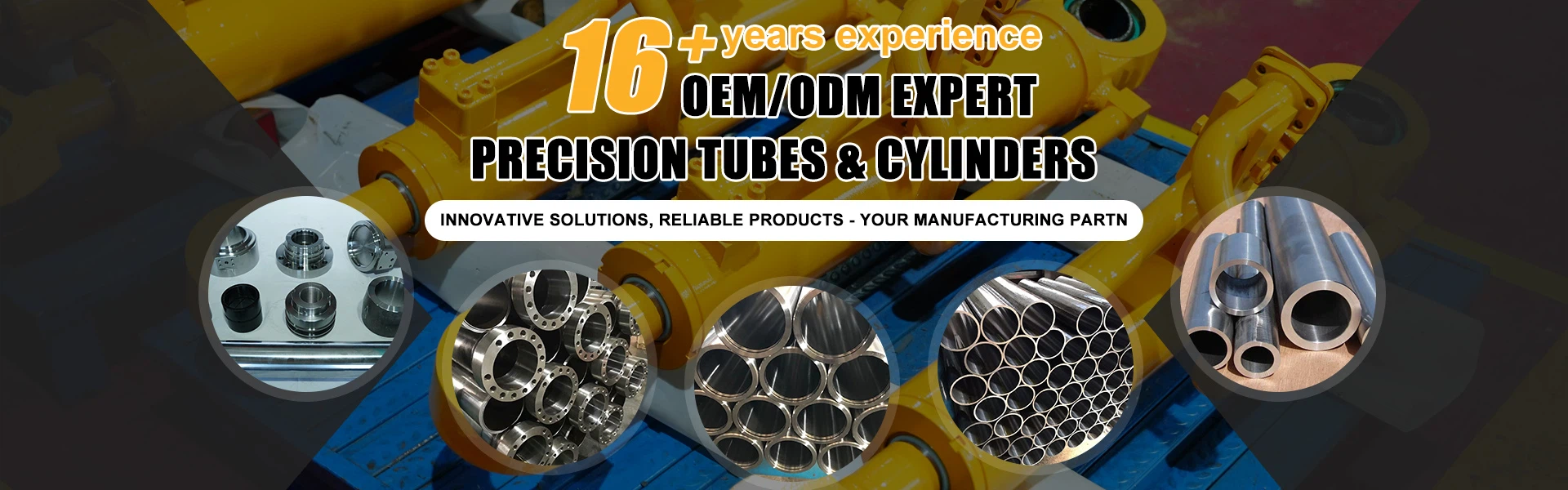
Hydraulic cylinders, as core actuators in hydraulic systems, convert hydraulic energy into mechanical energy and are widely used in industries such as industry, construction machinery, and aerospace. Their operating principle is based on Pascal's law, which states that pressure in a confined liquid is uniformly distributed, thereby driving a piston to produce linear motion. This article will discuss the hydraulic cylinder's structure, operating principle, classification, technical features, and typical applications.
1. Structure and Operating Principle of Hydraulic Cylinders
A hydraulic cylinder primarily consists of a cylinder barrel, piston, piston rod, seals, cushioning devices, and exhaust devices. The cylinder barrel, as a load-bearing component, is typically made of high-strength steel to ensure pressure resistance and stability. The piston is connected to the piston rod and slides within the barrel, driven by hydraulic fluid to produce linear reciprocating motion. Seals (such as O-rings and Y-rings) prevent hydraulic oil leakage and ensure system efficiency. Cushions mitigate the impact of the piston at the end of its stroke, protecting equipment from damage.
The operating principle of a hydraulic cylinder relies on the pressure differential in the hydraulic system. When high-pressure oil enters the rodless chamber (or rodless cavity) of the cylinder, it pushes the piston to the other side, thereby extending or retracting the piston rod. By controlling the flow and direction of the hydraulic oil, the speed and position of the hydraulic cylinder can be precisely adjusted.
II. Classification of Hydraulic Cylinders
Based on their structural form, hydraulic cylinders can be divided into the following categories:
1.Single-acting hydraulic cylinders: Driven in one direction only by hydraulic oil, the return motion is usually accomplished by a spring or external force. They are commonly found in simple lifting devices.
2.Double-acting hydraulic cylinders: Hydraulic oil can flow into both chambers, achieving bidirectional motion. They are suitable for applications requiring reciprocating motion, such as boom control in excavators.
3.Plunger hydraulic cylinders: Piston-type hydraulic cylinders have a piston rod at only one end. They are suitable for applications with long strokes but small loads, such as the lifting mechanism of a dump truck.
4.Telescopic hydraulic cylinders: Composed of a multi-stage sleeve, they can achieve large retraction and retraction strokes. They are commonly used in cranes or aerial work platforms. Furthermore, hydraulic cylinders can be categorized by mounting method, including trunnion, foot, and flange types, to accommodate different mechanical structure requirements.
III. Technical Features of Hydraulic Cylinders
Hydraulic cylinders offer the following significant advantages:
•High power density: They deliver high thrust and speed in a compact package, making them suitable for heavy-duty applications.
•Excellent controllability: Precise speed and position control is achieved through proportional or servo valves.
•Long life and reliability: High-quality materials and precision machining enable stable operation in harsh environments.
•Low-speed stability: Compared to electric actuators, hydraulic cylinders are less susceptible to creep at low speeds.
However, hydraulic cylinders also have limitations, such as high requirements for hydraulic oil cleanliness, relatively high system maintenance costs, and performance degradation in extreme temperatures.
IV. Typical Applications of Hydraulic Cylinders
Hydraulic cylinders play a key role in various industries:
1.Construction machinery: For example, the boom and dipper arm controls of excavators and loaders rely on hydraulic cylinders for precise movement. 2.
Metallurgical Industry: Used in rolling mill screw-down devices and ladle lifting mechanisms, they withstand extremely high loads.
3.Aerospace: Hydraulic cylinders provide reliable power support for aircraft landing gear retraction and extension, and hatch control.
4.Automated Equipment: Applications such as machine tool feed systems and robot joint drives can achieve intelligent control when combined with sensors.
V. Development Trends
With the advancement of industrial automation and intelligentization, hydraulic cylinders are evolving towards higher pressure, lighter weight, and more intelligent systems. The use of new materials (such as composite piston rods) increases strength and reduces weight, while intelligent hydraulic cylinders integrating displacement sensors and electro-hydraulic servo technology further enhance control precision, meeting the demands of modern high-end equipment.
Conclusion
As a key component of hydraulic transmission systems, hydraulic cylinders occupy an irreplaceable position in the industrial sector due to their high efficiency and reliability. In the future, with advances in materials science and control technology, hydraulic cylinders will continue to develop towards higher performance and greater intelligence, providing important support for automation upgrades in various industries.


