
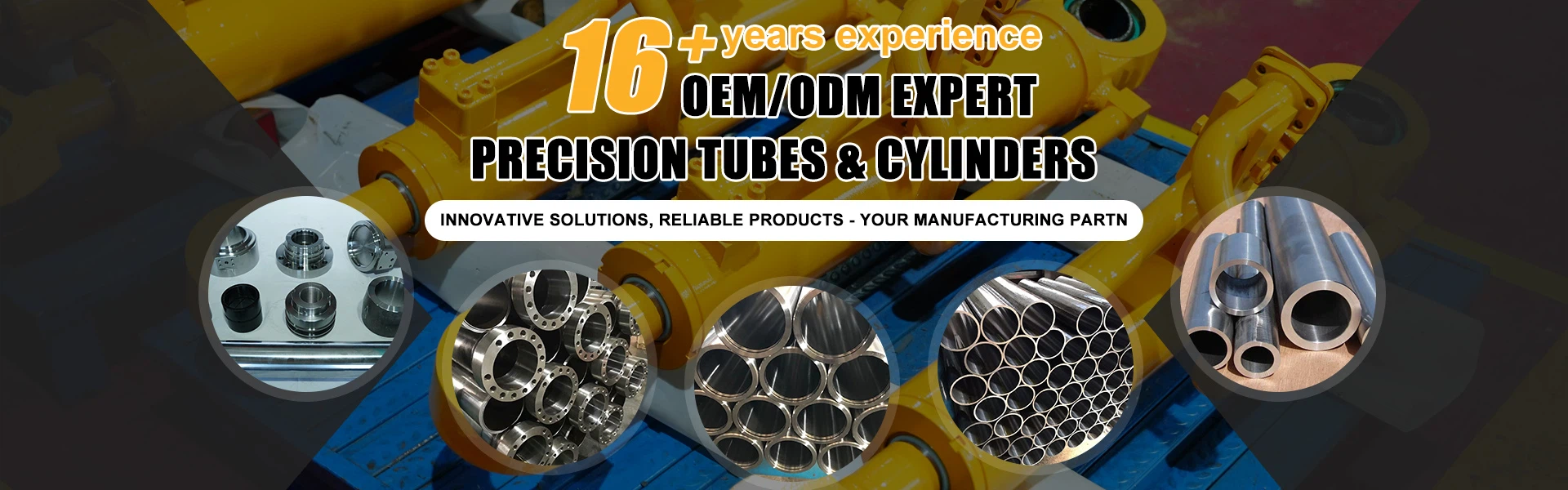


As core components in hydraulic and pneumatic systems, the performance of piston rod and cylinder bodies directly impacts the reliability and efficiency of the equipment. The choice of synthesis method not only determines the mechanical strength, sealing, and wear resistance of the cylinder body, but also affects manufacturing costs and service life. This article systematically discusses the main synthesis processes for piston rod and cylinder bodies, analyzes their technical characteristics and applicable scenarios, and provides a reference for engineering practice.
I. Material Selection and Pretreatment
The synthesis of piston rod and cylinder bodies primarily depends on the appropriate selection of the base material. Commonly used materials include high-strength alloy steels (such as 45 steel and 20CrMnTi), stainless steels (such as 304 and 316L), and aluminum alloys (suitable for lightweighting requirements). Steel is the mainstream material due to its excellent overall mechanical properties, while titanium alloys or composite materials may be used in special applications.
Pretreatment steps are crucial to the quality of subsequent synthesis. The base material undergoes a tempering heat treatment (quenching followed by high-temperature tempering) to increase hardness and toughness. The surface is then shot peened or rolled to create a residual compressive stress layer, which delays the onset of fatigue cracks. Stainless steel also requires pickling and passivation to remove scale and improve corrosion resistance.
II. Core Fabrication Processes
1. Welding
Welding is a traditional method for cylinder block fabrication, particularly suitable for medium and large cylinder blocks. Common processes include:
•Tiger arc welding (TIG/MIG): Using an inert gas shield, low-distortion, high-precision welding is achieved, making it suitable for thin-walled or precision cylinder blocks.
•Friction welding: Using frictional heat generated by high-speed rotation of the workpiece to create a connection, it eliminates fusion defects and is commonly used to bond piston rods to end caps.
Post-welding, stress relief annealing is required, and X-ray inspection is performed to ensure the absence of internal cracks.
2. Casting and Forging Combined Process
For complex cylinder blocks, casting can create features such as internal flow channels in a single process, but subsequent machining is required to compensate for any lack of precision. Forging improves metal flow distribution and significantly increases tensile strength. Modern processes often combine the two: forging the blank, then adding detailed structural features through precision casting, and finally CNC machining to achieve design tolerances. 3. Additive Manufacturing (3D Printing)
Emerging metal additive manufacturing technologies, such as selective laser melting (SLM), offer new approaches for cylinder block synthesis. This method can create topologically optimized structures difficult to achieve with traditional methods, such as internal cooling channels or lightweight lattices. However, due to limitations in material variety and surface roughness, it is currently primarily used for prototyping or small-batch customization.
III. Surface Treatment and Strengthening
The synthesized cylinder block requires surface treatment to meet wear and corrosion resistance requirements:
•Hard chromium plating: Deposits a 0.03-0.05mm thick chromium layer on the piston rod surface, achieving a hardness exceeding HV800. However, internal stress must be controlled to prevent cracking.
•Electroless nickel-phosphorus alloy plating: Provides a uniform corrosion-resistant coating suitable for complex internal cavities where electroplating is not feasible.
•Plasma spraying: Ceramic or tungsten carbide coatings enhance wear resistance under extreme operating conditions.
IV. Quality Control and Inspection
Critical parameters during the synthesis process, such as welding current and forging temperature, must be strictly monitored. Finished product inspection typically includes:
•Nondestructive testing: Ultrasonic testing (UT) detects internal defects, and magnetic particle testing (MT) identifies surface cracks.
•Dimensional accuracy: Coordinate measuring machines (CMMs) verify the geometric and positional tolerances of critical mating surfaces.
•Performance testing: Pressure testing, leak testing, and fatigue life assessment.
Conclusion
The assembly method for piston rod and cylinder bodies is a comprehensive fusion of materials science, machining, and surface engineering technologies. With the increasing reliability requirements of high-end equipment, multi-process collaborative optimization (such as forging + welding + surface hardening) will become a mainstream trend. In the future, the integration of additive manufacturing and intelligent monitoring technologies is expected to further promote the development of cylinder body assembly towards higher efficiency and customization.


