
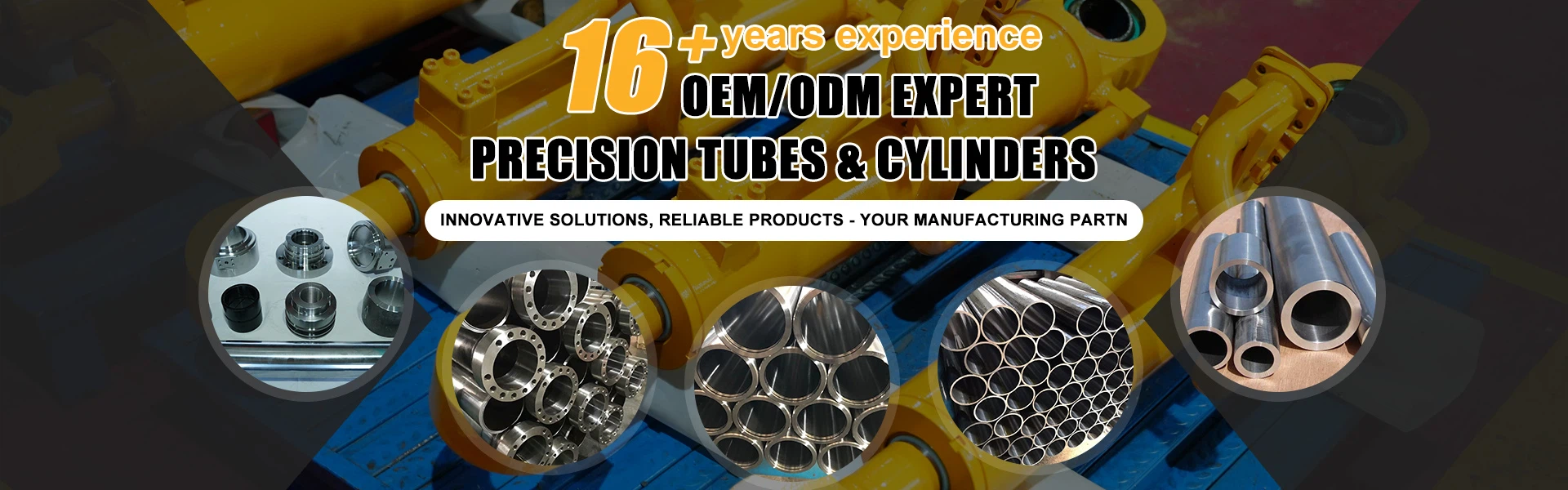


Piston rod cylinders are core actuators in hydraulic and pneumatic systems. They convert fluid pressure energy into mechanical energy, achieving linear reciprocating or oscillating motion. They are widely used in engineering machinery, automation equipment, aerospace, and other fields. Their operating principle is based on Pascal's law and the fundamentals of fluid mechanics. Pressure changes within a sealed chamber drive piston movement, which in turn drives the piston rod's output force and displacement.
Basic Structure and Components
A piston rod cylinder primarily consists of a cylinder barrel, piston, piston rod, sealing device, and liquid (gas) inlet and outlet ports. The cylinder is a cylindrical pressure-bearing container with a sealed working chamber. The piston is precisely fitted into the cylinder, dividing the chamber into a rod chamber (including the piston rod side) and a rodless chamber (the side without the piston rod). The piston rod is rigidly connected to the piston at one end and extends outside the cylinder to output power. Sealing devices (such as O-rings and Y-rings) are located at the contact surfaces between the piston and the cylinder, and between the piston rod and the cylinder head, to prevent fluid leakage and maintain chamber pressure. The inlet and outlet ports connect to a hydraulic pump or air source to control the directional flow of the fluid.
Working Principle Detailed Explanation
The core function of the piston-rod cylinder is to drive the piston through a fluid pressure differential. When high-pressure fluid (hydraulic oil or compressed gas) enters the rodless chamber through the inlet, the pressure in the rodless chamber increases, pushing the piston toward the rod chamber. During this process, the fluid in the rodless chamber is squeezed and discharged through the outlet. Because the piston area is larger than the piston rod's cross-sectional area (the effective area of the rod chamber is smaller than that of the rodless chamber), under the same pressure, the rodless chamber generates a greater thrust, extending the piston rod and exerting a greater linear force. Conversely, if high-pressure fluid enters the rod chamber and fluid is expelled from the rodless chamber, the piston retracts toward the rodless chamber, retracting the piston rod.
It is important to note that the direction and speed of the piston rod cylinder are determined by the pressure and flow at the inlet and outlet ports: pressure determines the magnitude of the output force (F = P × A, where P is the chamber pressure and A is the effective area), while flow (the volume of fluid flowing in/out per unit time) directly affects the piston's speed (v = Q/A, where Q is the flow rate and A is the effective cross-sectional area of the piston). By adjusting pressure and flow through a control valve group (such as a reversing valve or throttle valve), precise positioning, speed regulation, and direction reversal of the piston rod can be achieved.
Typical Application Scenarios
In construction machinery, the extension and retraction of excavator booms and the digging action rely on the coordinated operation of multi-stage piston rods and cylinders. Material push mechanisms on automated production lines utilize single-acting cylinders (one-way fluid inlet only, with return strokes relying on springs or external forces) to achieve efficient circulation. High-precision positioning platforms in the aerospace industry employ low-friction, high-sealing servo piston rods and cylinders to ensure precise control of minute displacements. Furthermore, in applications such as screw-down devices in metallurgical equipment and the retraction and deployment systems of ship anchor windlasses, piston rods and cylinders are key actuators due to their reliability and high load capacity.
Summary
Piston rods and cylinders use fluid pressure to drive piston movement, converting hydraulic or pneumatic energy into controllable linear mechanical energy. Their operating principle is essentially a mechanical equilibrium between pressure differential and applied area. With advances in materials science (such as high-strength alloy cylinders and low-friction sealing materials) and control technologies (such as electro-hydraulic proportional valves and intelligent sensor feedback), modern piston rods and cylinders are evolving towards high precision, long life, and low energy consumption, continuously providing core power support for industrial automation and high-end equipment.


